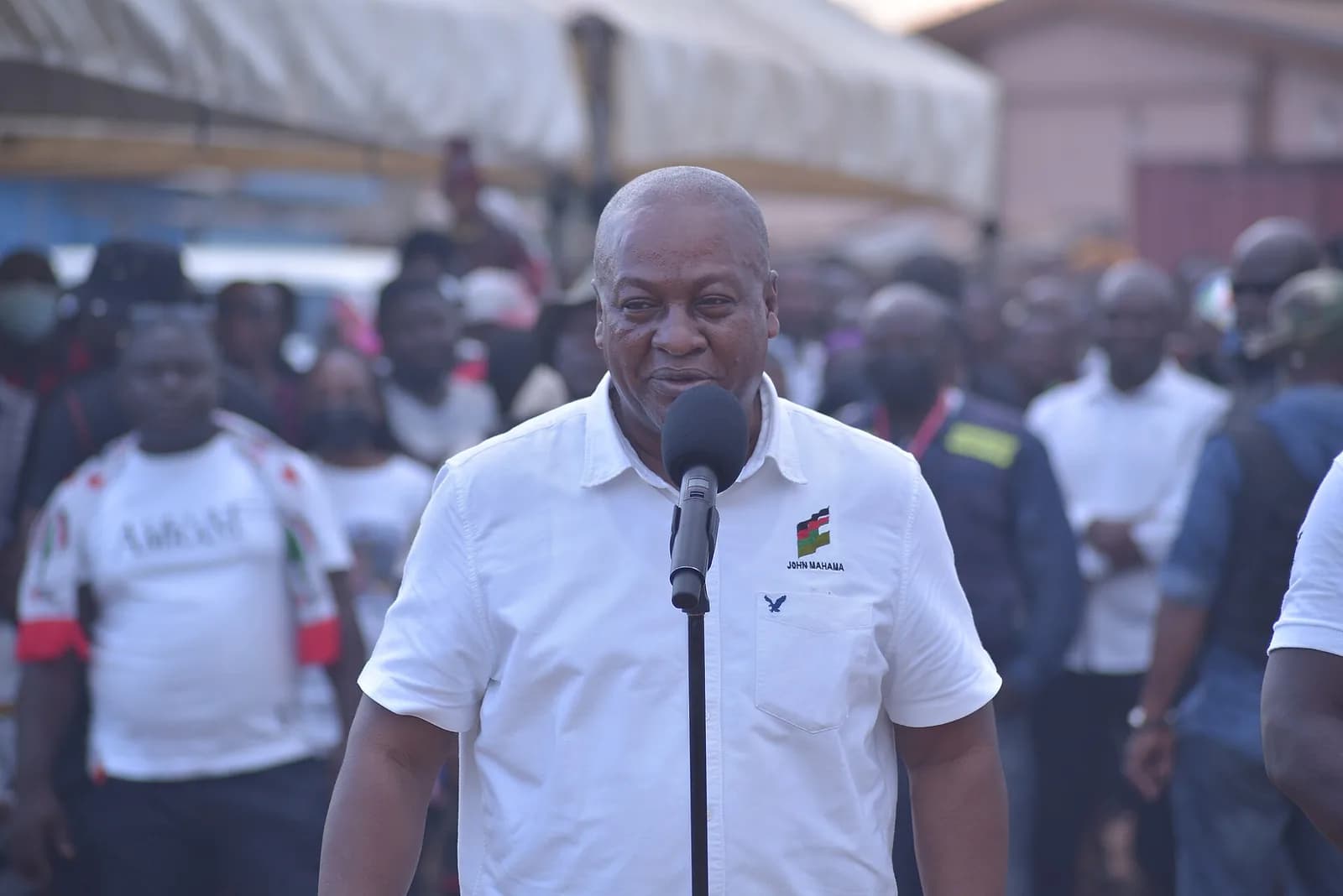
Mahama Rejects Emergency Declaration Talk
President John Dramani Mahama has stated plainly that he never put forward the idea of imposing a state of emergency as a way of tackling illegal mining, widely referred to as galamsey. He made the remark while addressing a town hall gathering of Ghanaians living in the Tri-State Area of the United States. Mahama explained that emergency declarations can be appropriate in certain situations, yet they ought to be kept as a measure of last resort.[S1]
The president explained that states of emergency are normally designed for crises confined to particular areas and lasting a limited time. He noted that such a declaration carries sweeping powers, among them limits on certain rights. He pointed out that detention without court appearance becomes possible under those conditions, and that the usual 48-hour rule does not hold once an emergency is in force. In his view, the authority remains available but must only be used as a final option.[S1]
Mahama argued that illegal mining's spread across ten regions of Ghana makes a state of emergency hard to apply. He described emergency declarations as typically confined to an isolated area, where all resources can be concentrated until the problem is resolved and the measure lifted. He asked where such a declaration would even be applied given how widely galamsey occurs.[S1]
Forest Reserves Cleared and New Security Approach
Mahama said his government has focused its efforts on forest reserves hit by illegal mining. Nine of these reserves have been cleared of illegal miners, he said, and the government has altered its method to stop them from coming back. In the past, the military would clear an area and then hand it over to forest guards, but illegal miners sometimes returned once the soldiers had gone.[S1]
Under the revised approach, military camps are being set up inside reclaimed forest reserves so a security presence remains and renewed encroachment can be prevented. The government had already announced plans to keep military detachments in reclaimed reserves because of worries that illegal miners might return after enforcement operations.[S1]
Water Guards and the Ankobra River
The president said water guards have been deployed, and that several changfan machines working on the Ankobra River were removed and destroyed. He cautioned, however, that clearing the main river channel by itself is insufficient, since multiple tributaries also flow into the Ankobra. More water guards will therefore be required to help the National Anti-Illegal Mining Operations Secretariat (NAIMOS) clear the affected areas, he said.[S1]
Mahama further disclosed that the Finance Minister has consented to release additional funds so that a greater number of young people can be recruited and trained as water guards. He conceded that the campaign is a complicated and far from simple struggle, yet he gave his word that his administration would not give up on it and would sustain the effort. His comments were made as enforcement against illegal mining carries on across forest reserves and water bodies.[S1]