The tower arms close on the ship
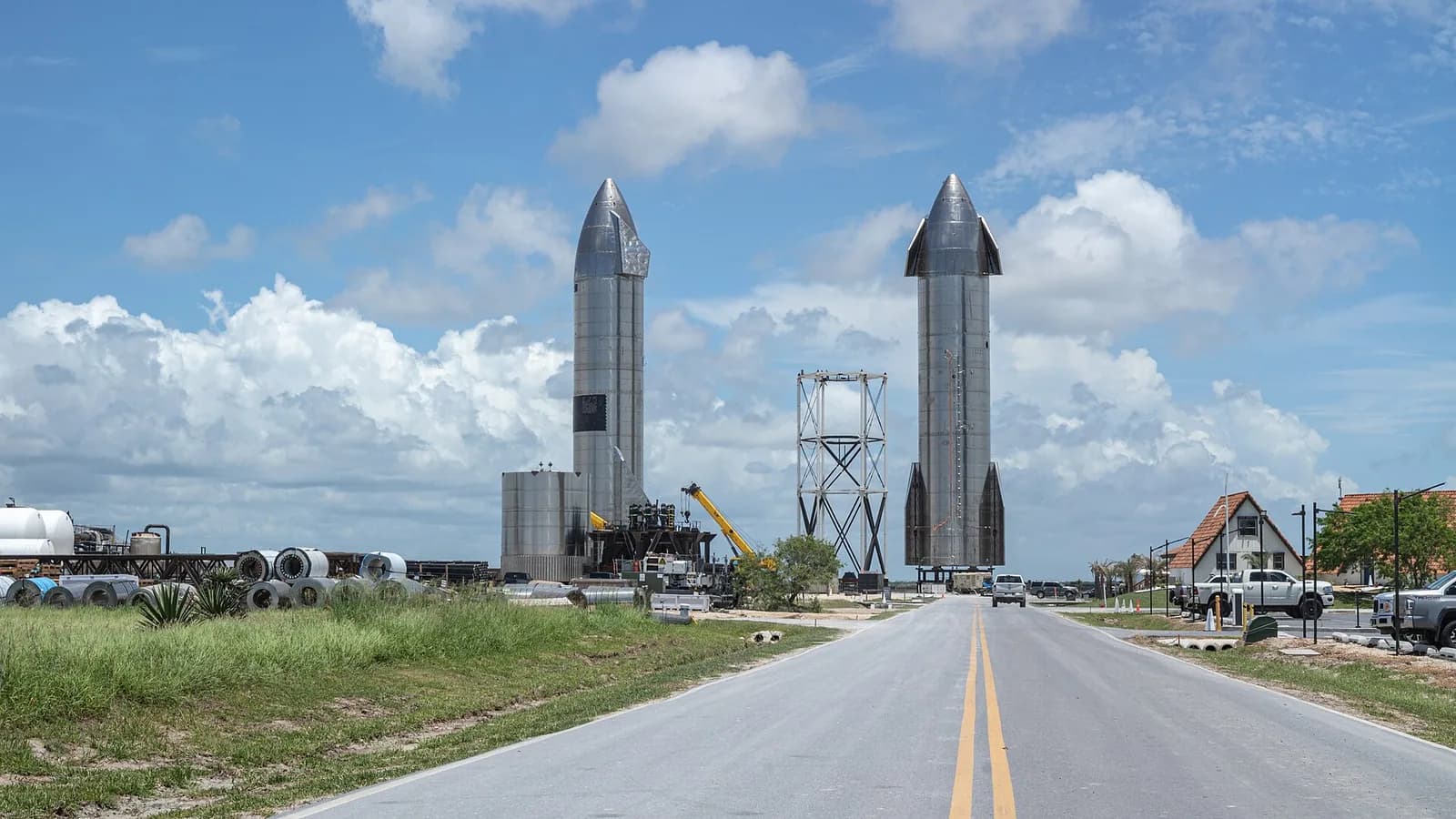
SpaceX brought the upper section of its giant Starship rocket back to Earth and held it hovering beside the launch tower, where the mechanical arms known as chopsticks gripped and secured it. The company's employees who were following the flight cheered when the ship arrived at the Starbase site in Boca Chica, Texas. It was the fifteenth Starship test and the first in which the company set out to recover both parts of the vehicle.[S1][S3][S4][S6]
The rocket, 124 meters tall, lifted off from the Starbase pad at 16:47 local time on Friday. The plan called for the lower stage, the Super Heavy booster, to be caught six and a half minutes later as it came back down. Instead the booster triggered an automatic abort and diverted over the ocean, where it hung above the water before exploding. Elon Musk later wrote on X that the booster had a slightly low fuel level.[S1][S5][S7]
The upper stage continued into space, where it released 26 satellites belonging to the Starlink constellation, which supplies high-speed internet. The ship circled the Earth 14 times before heading back to the launch tower. SpaceX had already caught the Super Heavy booster on three earlier test flights, but this was the first time the upper stage, which first reached orbit in September, was held by the chopsticks.[S1][S7]
Before the flight, SpaceX said it would attempt to catch the ship only after carefully assessing the vehicle while it was in space. Any problem would have sent it into the ocean the same way as the booster.[S1]
A long-held goal of full reuse
Building a fully reusable rocket is an ambition SpaceX has pursued for years. In 2015 it became the first company to land part of a rocket vertically, with its Falcon 9 booster. Falcon 9 rockets now fly more than 100 times a year, and reusing the lower stage has sharply reduced launch costs. Malcolm Macdonald, president of the Royal Aeronautical Society, says that bringing a complete Starship down would take spaceflight to another level, though that did not happen on this occasion.[S1]
Losing the booster is a setback, but the company has recovered it before, so the return and successful recovery of the other section amount to substantial progress. SpaceX has now shown it can master each half of the recovery challenge, though not yet on the same flight. The next milestone would be to combine the two achievements and demonstrate that they can be repeated reliably and economically.[S1]
Shareholders have been watching these flights closely since SpaceX's stock market listing earlier this year, and so has NASA. Progress on Starship has direct consequences for the agency's effort to put humans on the Moon in 2028, a highly ambitious deadline.[S1]
The race to the lunar surface
NASA awarded SpaceX a contract to adapt the ship as the lander that would ultimately carry astronauts to the lunar surface. Blue Origin, owned by the technology billionaire Jeff Bezos, also holds a contract to use its New Glenn rocket and lander for a Moon landing. Both companies will play key roles in the Artemis III mission, currently scheduled for the summer of 2027, another demanding timetable.[S1]
During that trip, four astronauts aboard NASA's Orion spacecraft will maneuver close to the lunar modules from SpaceX and Blue Origin and attempt to dock with them. Starship will have to advance considerably in the coming months to meet those commitments, since the rocket's development has been much slower than SpaceX anticipated.[S1]
Blue Origin also has much work ahead. The company suffered a severe blow earlier this year when its rocket exploded, completely destroying its launch pad in Florida. Blue Origin had said its spacecraft would be operational again by the end of this year, but the return to flight has slipped to early 2027. NASA is under pressure to meet its own deadlines as well: its administrator, Jared Isaacman, has noted that the United States is competing with China to reach the Moon, and China intends to land its taikonauts on the lunar surface by 2030.[S1]