Court orders release after nearly 24 hours
A Delhi executive court on Sunday granted release to Cockroach Janta Party founder Abhijeet Dipke along with fellow leaders Saurav Das and Ashutosh Ranka, according to the youth-led movement. The trio had been taken into custody before a major Saturday demonstration in the capital and were brought before a court earlier Sunday following roughly a day behind bars. The CJP had claimed the leaders were held at an unknown site with no lawyer access. Ratna Singh, the group's lead counsel, announced the release order in a social media post. AFP journalists watched Dipke, in a white shirt, depart in a black car.[S1][S2]
The CJP's three central figures — founder Abhijeet Dipke and co-conveners Saurav Das and Ashutosh Ranka — were taken into custody aboard an aircraft the moment they touched down in New Delhi for the demonstration, flying in from Mumbai. On Saturday evening the group renewed its appeal for a Sunday march to Jantar Mantar in the capital. Ajinkya Shinde, who is leading the CJP's interim protest efforts, told a press conference that the movement would refuse to yield and would return to Jantar Mantar the following day.[S1][S2]
Thousands detained as Delhi locks down
On Saturday police carried out a vast security crackdown throughout the capital, holding thousands of people to stop demonstrators from assembling at the Jantar Mantar protest venue, as reported by the CJP and Indian outlets. The precise figure of those held was not immediately confirmed. Shinde told journalists that more than 15,000 people, students among them, had been detained nationwide. The Hindu, quoting Delhi Police sources, said 2,500 protesters were held in Delhi in addition to 1,000 taken in overnight preventive detentions before the protest. Indian media, citing Delhi Police, said every detainee had been freed later Saturday.[S1]
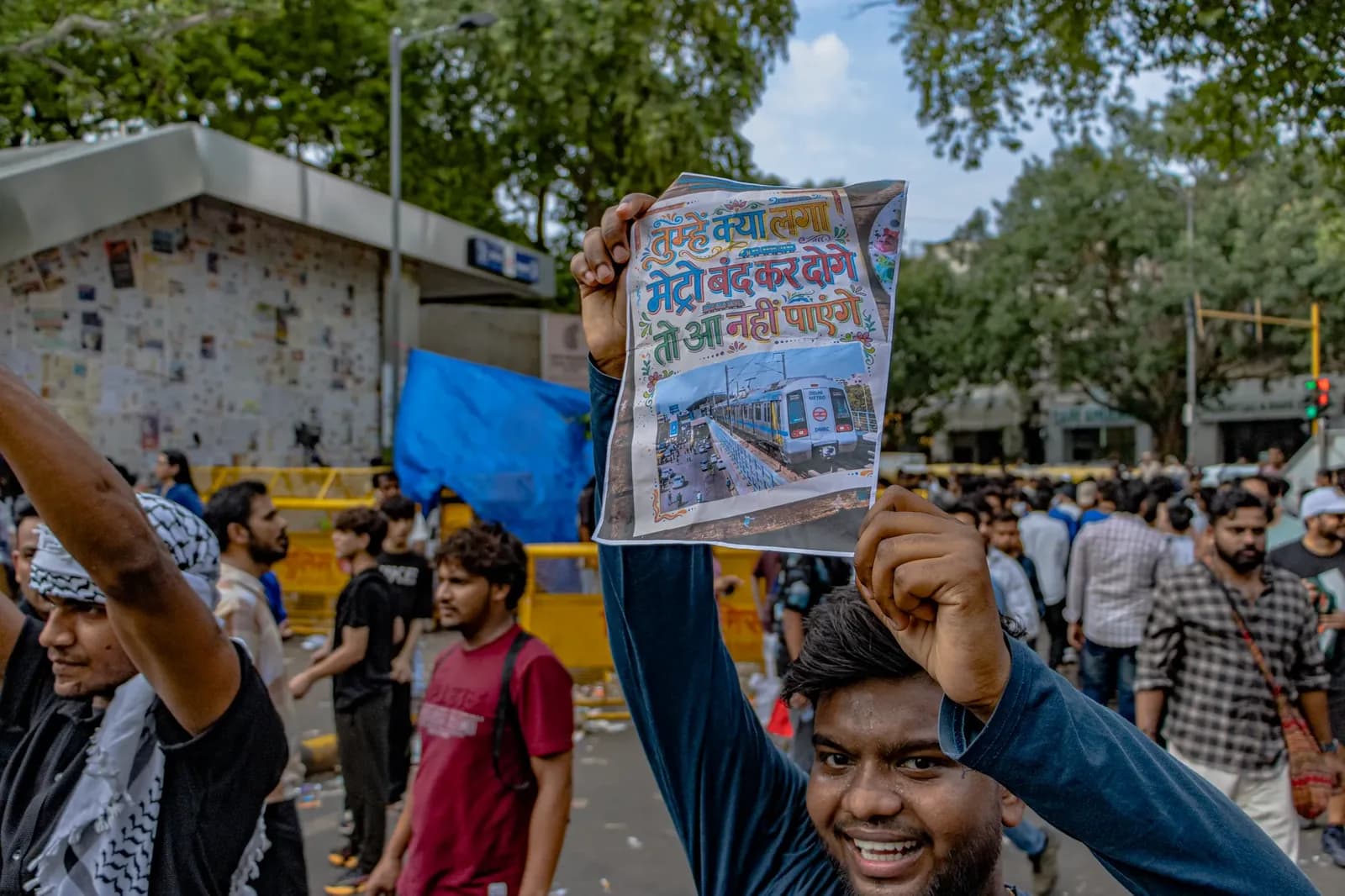
Striking scenes played out across the capital of the world's largest democracy on Saturday as officials moved to block a demonstration organized by the Cockroach movement, which is demanding that India's election chief step down. Thousands of young protesters were taken into custody and carried off in buses while sections of Delhi were sealed under a huge police and paramilitary presence that effectively exceeded the number of demonstrators. Mobile internet was cut in central Delhi, an unusual step for the key power district, and dozens of metro stations shut. Police pointed to a protest ban as grounds for the mass detentions. The CJP and allied student groups insisted no permission was required, calling protest a fundamental right.[S1]
Voter-roll dispute and mounting pressure
The demonstration caps weeks of opposition organizing that followed claims of irregularities in a nationwide voter-roll revision. According to media accounts, the revision led to over 133 million names being struck from electoral lists. Election officials describe the exercise as a way to clear duplicate, deceased and fraudulent entries. Detractors argue it has hit minorities, especially Muslims, disproportionately, possibly aiding Prime Minister Narendra Modi's governing Hindu nationalist Bharatiya Janata Party. The Election Commission of India has denied any wrongdoing.[S2]
Saturday's detentions drew strong condemnation from opposition figures, who charged that Modi's government was suppressing dissent, among others. In Geneva, the UN High Commissioner for Human Rights urged the immediate and unconditional freeing of everyone arbitrarily held in New Delhi. The CJP and opposition leader Rahul Gandhi both pledged to continue protesting despite the crackdown. Gandhi said his Congress party and the nation's youth would return to the streets in force on Monday, adding that harsher government repression would only deepen the anger of Gen Z and students. Four former state chief ministers were also briefly detained during the protest, as opposition parties intensified demands for the resignation of Chief Election Commissioner Gyanesh Kumar.[S1][S2]