Wall Street's worst session since April 2025
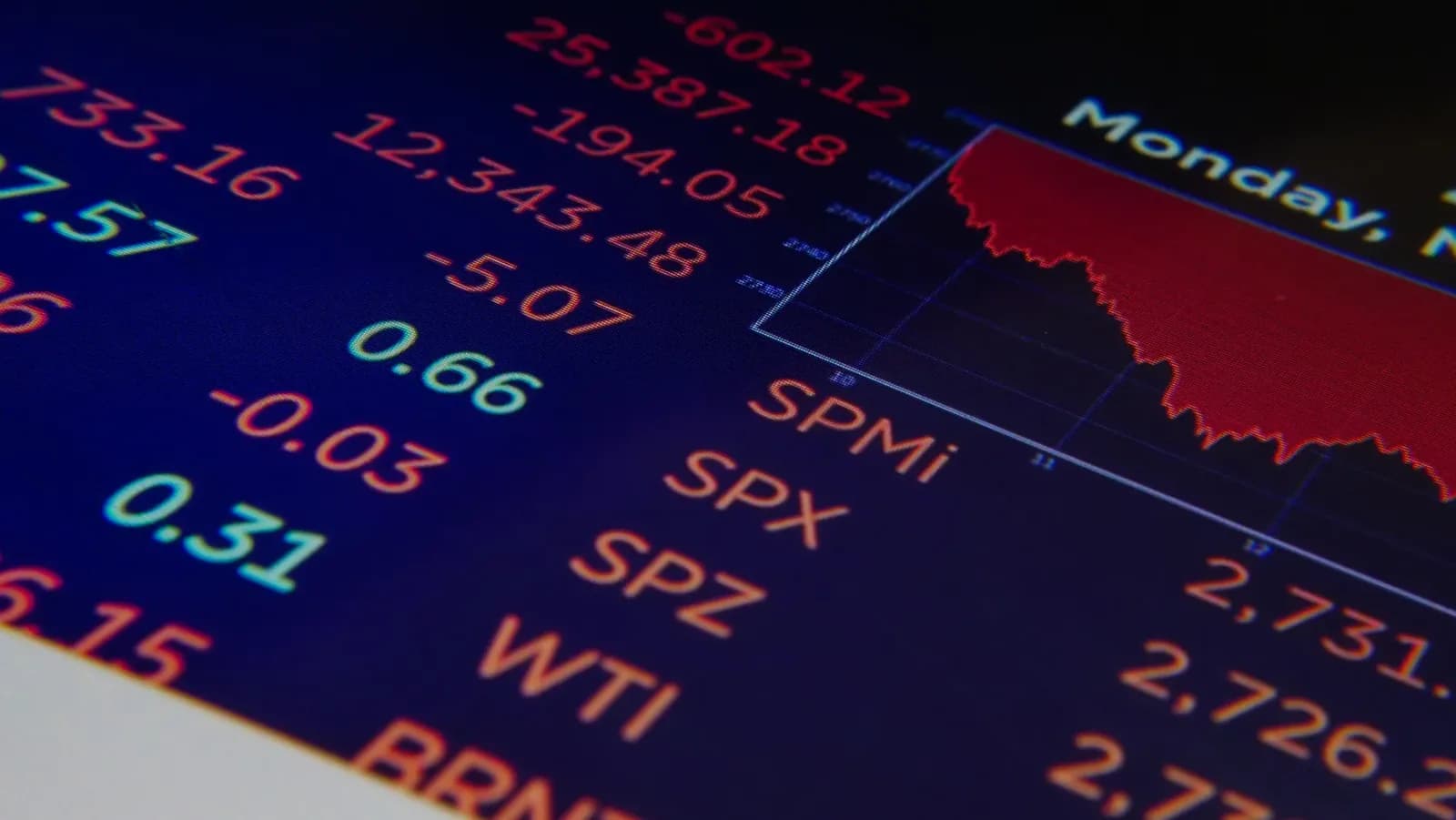
Thursday's regular session delivered the steepest one-day declines for all three major U.S. averages since April 2025. The Nasdaq Composite dropped 5.5%, ending more than 10% under its latest peak and thereby entering correction territory. The S&P 500 gave up 4.4%, and the Dow Jones Industrial Average lost over 1,800 points, equal to 3.4%. Every one of the S&P 500's 11 sectors finished lower, with companies connected to artificial intelligence construction hit hardest.[S1][S4]
Among individual names, Micron Technology and Advanced Micro Devices each fell 17%, while the neocloud provider CoreWeave slipped 10%. Nvidia declined 9%, moving into negative territory for 2026, and the Magnificent Seven group of technology giants collectively lost more than $1 trillion in market value.[S1]
Asia follows Wall Street lower
Declines rippled through Asian markets, and South Korea posted the region's steepest drop as the Kospi tumbled over 6%. In Japan, the Nikkei 225 shed 5.9%, a slide that pushed the index into bear market conditions. Australia's S&P/ASX 200 gave up 0.9%, the Hang Seng Index in Hong Kong dropped 1%, and the CSI 300 on mainland China fell 1.47%.[S1][S2][S5]
Early Friday, U.S. futures were mixed. S&P 500 futures held roughly flat, Nasdaq-100 futures gained 1%, and futures tied to the Dow Jones Industrial Average dropped 467 points, or 0.91%. For the week, the Nasdaq was down 4.4% and the S&P 500 nearly 3%, while the 30-stock Dow had lost just 0.5%.[S1][S3]
Politics, payrolls and a possible discount
Traders attributed part of the anxiety to Democratic victories in the House and Senate and in key governorships including Texas, which raised concerns about a possible slowdown in data center construction. A further catalyst arrives Friday morning with the October payrolls report; the Dow Jones consensus forecast is 59,000 jobs added and an unemployment rate steady at 4.2%.[S1]
Victoria Greene, chief investment officer at G Squared Private Wealth, told CNBC that the AI trade was not finished and described the pullback as an attractive discount. She said she was focused on memory stocks, noting that management teams have discussed capacity constraints throughout earnings season, and argued that purchasing into volatility tends to pay off while the economy avoids recession.[S1]