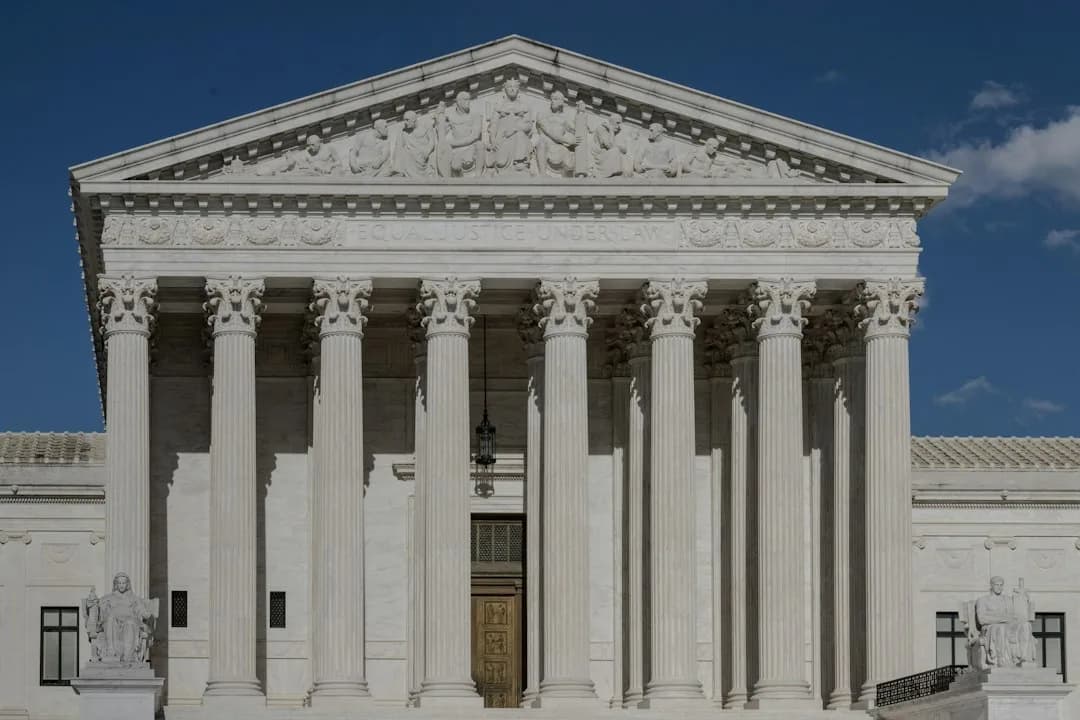
Supreme Court lifts block on third-country deportations
The US Supreme Court has ruled that the Trump administration may resume deporting immigrants to third countries, meaning nations other than their own, without allowing them to challenge their removal. The court's six conservative justices temporarily set aside a lower court decision that had obligated the administration to give immigrants adequate notice and a chance to express fear of torture or persecution in the destination country. The move allows removals to proceed while litigation continues.[S1]
The administration had asked the justices to intervene after the lower court imposed the notice and fear-claim requirements. By lifting that decision on a temporary basis, the high court's conservative majority has enabled the policy to operate without those procedural protections for now. The dispute remains part of a broader set of legal challenges to the administration's immigration enforcement.[S1]
Other legal battles involving the administration
The administration likewise petitioned the Supreme Court for permission to withhold gender-affirming care from transgender inmates in federal custody. Solicitor General D John Sauer contended that gender-reassignment operations, hormone treatments, and social provisions like undergarments, cosmetics, padding, and wigs could no longer be defended. In a separate action, the union representing over 8,000 Environmental Protection Agency employees filed suit against the EPA and its administrator, Lee Zeldin, claiming the unlawful cancellation of a collective bargaining agreement.[S1]
Elsewhere, President Donald Trump has dropped his effort to block payment of the $5m judgment E Jean Carroll won in her 2023 civil case accusing him of sexual abuse and defamation. Because the money had already reached her, the decision amounted to a procedural formality. Meanwhile, the Senate turned down a Democratic resolution, mostly on party lines, that would have compelled the State Department to inform Congress about violence in the occupied West Bank, among it the deaths of nine American citizens at the hands of Israeli settlers or security personnel in recent years.[S1]
Tech, AI, and other developments
Trump said the leaders of America's biggest technology and artificial intelligence firms had put their names to a pledge, binding only in a moral sense, to impose safeguards on AI. He presented the arrangement following a White House lunch with senior tech figures, characterizing it as permitting extensive self-regulation of their products and technologies. The blueprint for setting safety standards stays undefined. Trump additionally signed an executive order that renames artificial intelligence as superintelligence, repeating a statement he had made at the United Nations a week earlier.[S1]
Barely a day after OpenAI announced it was abandoning the release of a model because of safety worries, the firm rolled out a fresh set of AI offerings, among them dots, agents it called more ambitious than ChatGPT, and what it termed an entirely new method of working with AI. Separately, a passenger aircraft departing Dubai made an emergency landing in Saudi Arabia, momentarily sparking hijacking fears and leading Israel to send up warplanes; accounts attributed the episode to a dispute between the plane's two pilots, and all aboard were unharmed.[S1]