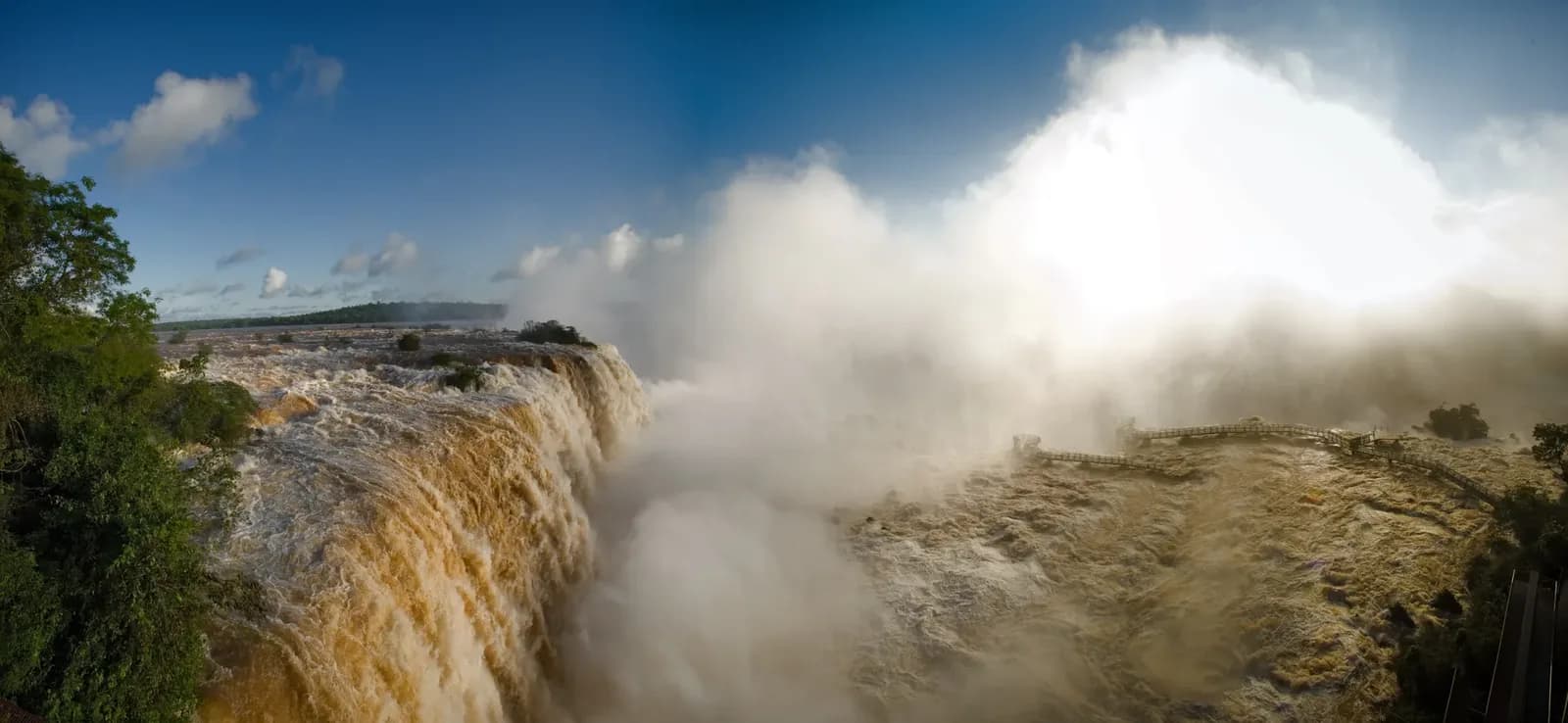
A River Triples and a Park Shuts
The Iguazu River's flow tripled in less than two days, prompting Argentina's National Parks administration and its concessionaire to suspend visitor entry to Iguazu Falls on Monday. By that morning, more than 12,000 cubic meters per second were plunging over the 275 falls — close to nine times the normal rate. Heavy rain has battered the Triple Frontier region and the Iguazu's upper basin for days under El Niño's influence, and forecasts suggest relief will not arrive until Thursday.[S1]
The park's management and the company Iguazu Argentina, which holds the service concession, said in a short statement that the river had exceeded 12,000 cubic meters per second, requiring a preventive safety protocol to protect visitors and workers. They described a temporary restriction on movement and access to public-use areas of Iguazu National Park, adding that the impact of the flood on the park's circuits and infrastructure would be assessed and inspected throughout the day.[S1][S2]
The surge was rapid. On Saturday morning the river was below 4,000 cubic meters per second. Twenty-four hours later it had climbed to 8,500, its water turning steadily redder. By 6 p.m. Sunday it had reached 11,500 cubic meters per second. On the Argentine side, 9,000 tourists had entered the park over the weekend, and delays of up to three hours built up at the Tancredo Neves international bridge crossing into Brazil.[S1]
Garganta del Diablo Dismantled in Advance
Because of El Niño, Iguazu Argentina and National Parks had already dismantled the walkway leading to Garganta del Diablo, the most spectacular of the 275 falls. The unprecedented step was meant to keep the announced extraordinary floods from damaging the structure. The dismantling took more than 40 days, and the floors and railings were stored on solid ground.[S1]
The precaution follows recent history. In 2023 the river's flow exceeded 20,000 cubic meters per second and tore away more than half of the walkway. A similar event a year earlier also caused damage that took months of work and a large investment to replace the sections dragged into the Iguazu canyon.[S1]
Orange Alert and a Divided Border
The National Meteorological Service issued an orange alert for northern Misiones for rain and storms on Monday afternoon. It warned that the area would be hit by strong, locally severe storms possibly bringing heavy short bursts of rain, hail of various sizes, frequent lightning and intense gusts that could exceed 90 km/h. Accumulated rainfall was expected to reach between 50 and 90 mm, with isolated spots possibly exceeding that.[S2]
Park superintendent José Hervas said the decision followed days of intense rain. He noted that 300 mm fell in two and a half days, the equivalent of a month's average for this time of year, and that the Garganta had been closed since August 1 before a new assessment led to the full closure. He said the Garganta balcony was under water and that on Monday the water was very close to the upper walkway, while rain continued heavily after the park shut on Sunday afternoon. He added that visitors understand the measure because the situation warrants it.[S2]
On the Brazilian side, a walkway was also closed on Sunday when the flow reached 8.8 million liters per second, nearly six times the historical average. The main trail and viewing points remained open, but other circuits were temporarily shut. Hervas said conditions there are entirely different because the river strikes from another direction, with Brazil on the inside of the bend and Argentina on the outside.[S2]