Futures and prediction markets converge on a December increase
Traders in federal funds futures now put an 88.5% probability on the Federal Reserve raising its benchmark rate by a quarter point at its Dec. 8-9 gathering, according to the CME Fedwatch tool and data reviewed by Bitcoin.com News on Saturday morning. The remaining 11.5% is assigned to a half-point move, and no probability is given to rates staying put or being cut.[S1][S2]
The federal funds target range currently sits between 3.75% and 4%. A quarter-point increase would lift it to 4%-4.25%, while a half-point adjustment would put it at 4.25%-4.5%. Expectations have shifted sharply: on Nov. 6, CME showed a 23.7% chance of no change and 76.3% for a quarter point, and by Saturday the half-point scenario had appeared at 11.5%.[S1]
Prediction venues tell a similar story with somewhat different methods. Kalshi traders priced a quarter-point increase at 89% against 10% for a larger move, on roughly $14.3 million of volume in its December decision market. Polymarket showed 88% and about 9%, with cumulative volume above $33.7 million. Both platforms kept around 4% on unchanged rates, unlike CME's futures-derived figures.[S1]
These figures show what traders anticipate, not what the central bank has decided. The Federal Open Market Committee has yet to disclose its December outcome, the three platforms differ in how they calculate prices and structure their contracts, and a substantial stretch of time remains before the year-end decision is made.[S1]
Inflation, energy and hiring push expectations higher
Inflation has moved to the center of the debate. October's consumer price index rose 0.4%, above the 0.3% economists forecast, while core inflation climbed 0.3%, also beating expectations. Stubborn price pressures have reinforced the case for further tightening.[S1]
Energy costs have clouded the picture. Brent crude's climb past $100 a barrel and elevated diesel prices have raised transportation expenses, with the risk that those costs spread into food, services and consumer goods.[S1]
Conditions in the jobs market have likewise weakened the case for holding back. U.S. payrolls added 165,000 positions in October, far surpassing forecasts of roughly 65,000, which gives officials more leeway to weigh steeper borrowing costs. Federal Reserve Gov. Christopher Waller has endorsed further tightening and floated the possibility of a half-point move if underlying inflation remains high, while other policymakers have flagged worries about stubborn price pressures, even as the appropriate pace of tightening stays contested.[S1]
Bitcoin tests $65,000 as speculative markets wobble
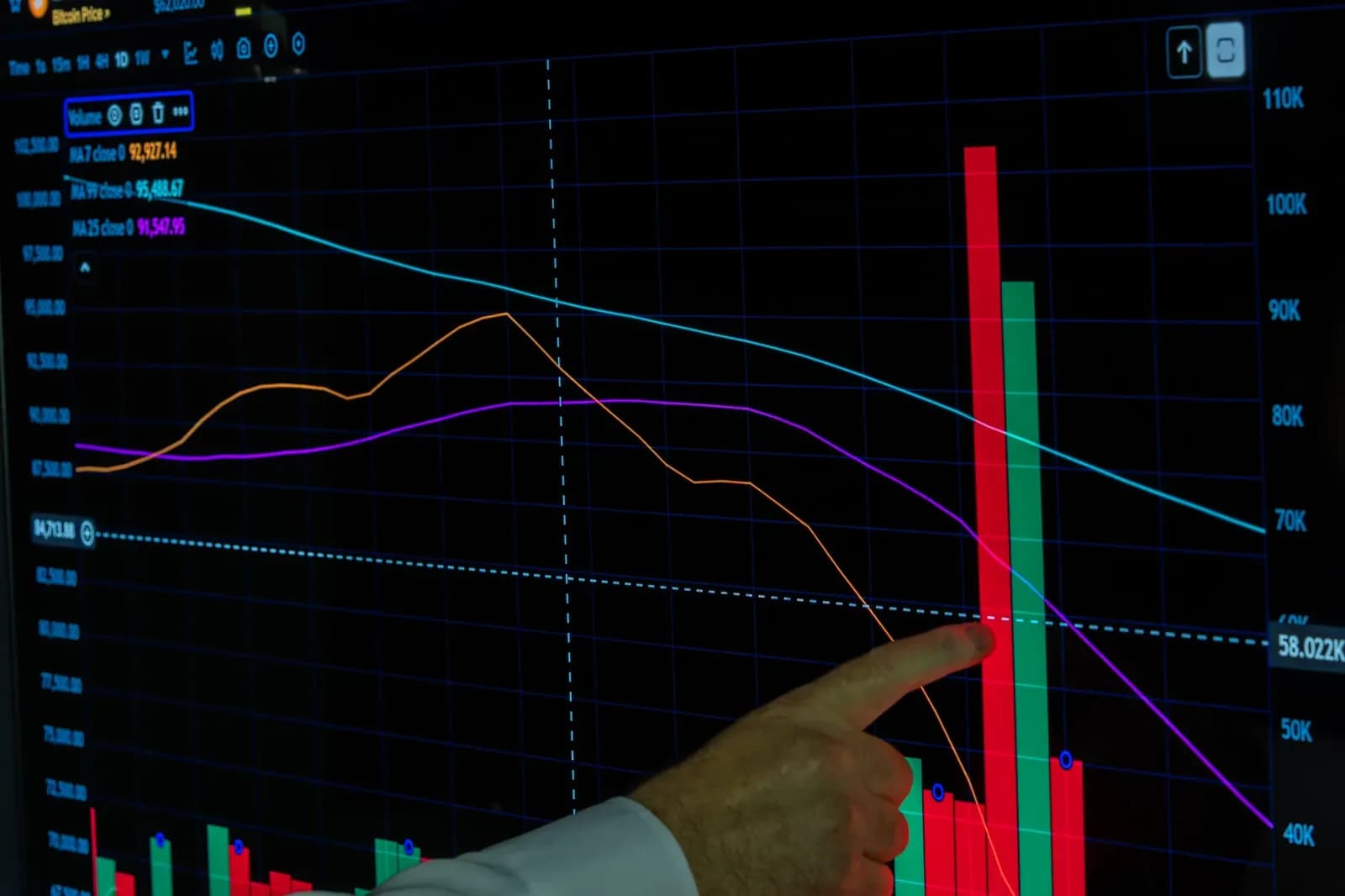
Bitcoin's slide offers another sign of anxiety in speculative markets. A 30-minute Bitstamp chart showed the cryptocurrency falling from $72,128 to $65,020 before a modest recovery to $65,274 around 11:14 a.m. EST, with successive lower highs and lower lows on heavy selling volume.[S1][S3]
Immediate support sits near $65,000, with $66,000 as the first significant resistance. A sustained break lower could expose the $64,500-$64,000 area. The intraday low of $65,020 brought $1 billion in 24-hour liquidations across crypto, of which $382 million were bitcoin wipeouts.[S1]
Higher rates can weaken the appeal of speculative assets by raising financing costs and making interest-bearing alternatives more attractive. Still, bitcoin's decline cannot be pinned on Fed expectations alone; other factors include uncertainty over Strategy's MSCI index listing and outflows from exchange-traded funds. With the December decision approaching, investors face stubborn inflation, the prospect of further tightening and a bitcoin price struggling to find a convincing floor.[S1]