Newsoras
Truth above all
Newsoras

Create your Newsoras account

Log in to Newsoras

World··2 min read·

Fastest Star Ever Found Orbits Milky Way's Black Hole

S301 races around Sagittarius A* at 8% light speed, offering a new way to measure black hole spin.

Fastest Star Ever Found Orbits Milky Way's Black Hole
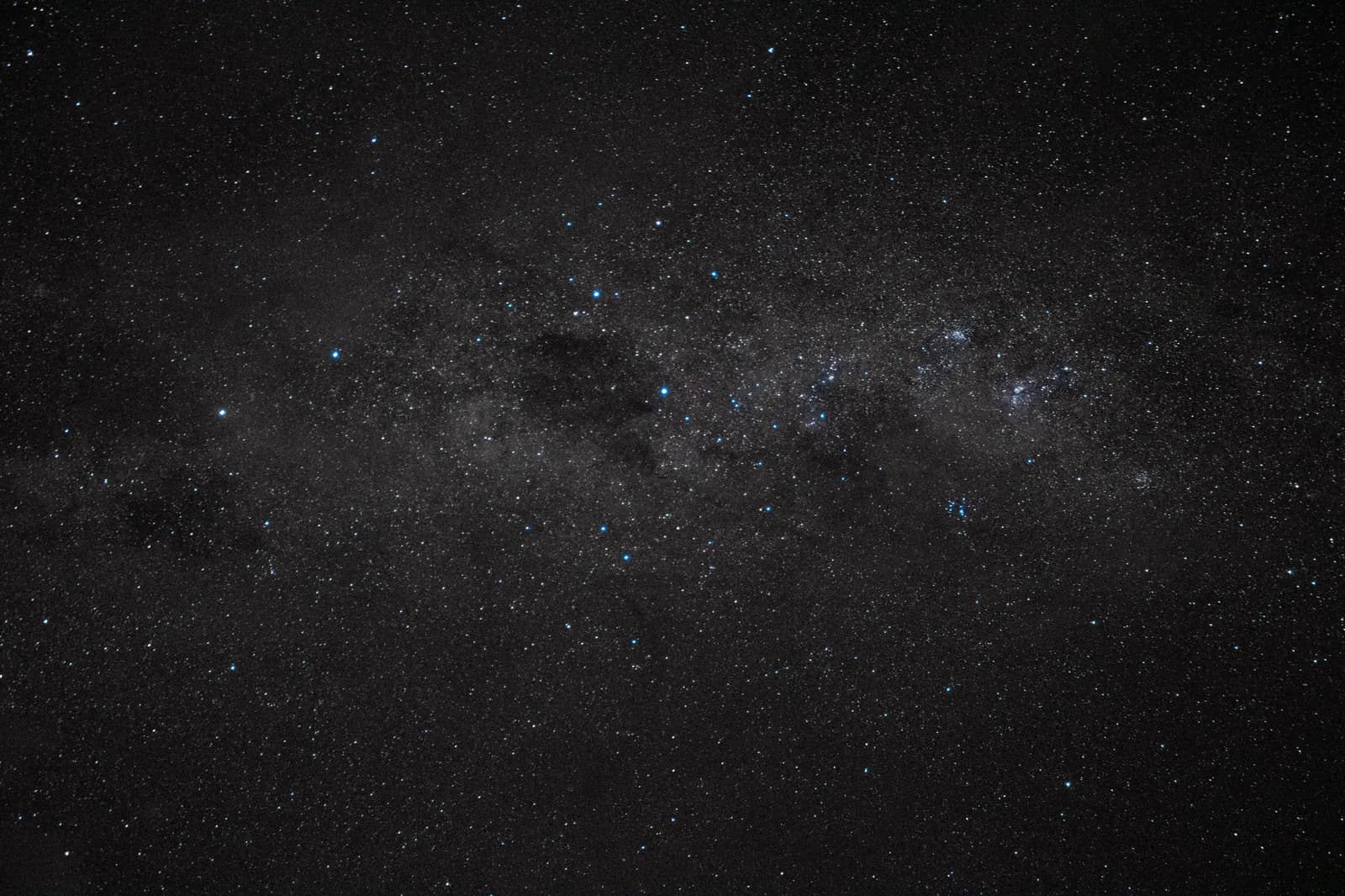
Image: Jakson Martins / Pexels — pexels
GO DEEPER WITH NEWSORAS

Understand this article deeper

A Record-Breaking Star

In a groundbreaking discovery, astronomers have located the Milky Way's speediest star, S301, which whizzes around the supermassive black hole Sagittarius A* at the galaxy's core. This star's velocity is an astonishing 25,000 kilometers per second, or 8% of light speed, making it 100,000 times quicker than a commercial jet. S301 completes an orbit in just 8.7 years, reaching as near as 11.5 astronomical units to the black hole, a distance slightly farther than Saturn's from the Sun.[S1][S2][S3]

S301's orbit is uniquely close and elliptical, bringing it nearer to the black hole than any other star. This closeness causes the star to experience the black hole's rotation, a phenomenon predicted by Einstein's theory of general relativity. The theory explains that a rotating black hole pulls spacetime with it, distorting the paths of nearby stars.[S1][S2]

A Window into Black Hole Spin

Scientists have long faced the challenge of directly measuring the spin of Sagittarius A*, a supermassive black hole. The recent discovery of S301, the fastest star in the Milky Way, presents a groundbreaking opportunity. Stefan Gillessen, a senior scientist at the Max Planck Institute for Extraterrestrial Physics (MPE) and co-author of the study in Nature, explains, "This is a significant breakthrough as it allows us to directly measure the spin of a massive black hole, providing a crucial test for Einstein's theory." The star's proximity to Sagittarius A* enables an unprecedented exploration of the black hole's properties and its extreme environment.[S1][S2]

Scientists have calculated S301's path since 2017 and aim to collect sufficient data during its 2031 close approach to determine the black hole's spin within 10 years. They utilized the Very Large Telescope Interferometer of the European Southern Observatory in Chile, merging light from four telescopes to form a high-resolution virtual telescope.[S1][S2][S3]

Origin and Future Observations

S301's peculiar path through space is likely the aftermath of a powerful gravitational event. Astronomer Gillessen theorizes that this star was once part of a binary system that ventured perilously close to the black hole. In a dramatic three-body interaction, the gravitational forces ripped the pair apart, ejecting one star from the galaxy and trapping S301 in a tight orbit around the black hole.[S2][S3]

S301's orbit is secure, despite its close approach to the black hole. It won't cross the event horizon, as its orbit is stable and not decaying, according to Gillessen. The star was discovered in 2023, and ongoing research aims to uncover more details with the aid of future telescopes.[S2][S3]

Sources: Google News · Independent · Biggo · AbcnewsView sources
Portrait of Niccolò Machiavelli

Ask a Thinker about this article

GO DEEPER WITH NEWSORAS

Understand this article deeper

WATCH & LISTEN
WHAT THEY'RE SAYING
  • For the first time, we would actually be able to measure very directly the spin of a massive black hole, which would be a key test of Einstein's theory.
    Stefan GillessenSenior scientist at Max Planck Institute for Extraterrestrial Physicsvia Google News

    Gillessen explains the significance of the discovery of star S301, which could allow direct measurement of the black hole's spin.

  • What is special about this star is that it's orbiting Sagittarius A* on a very tight orbit, taking just 8.7 years to complete it, and is approaching the black hole at a mere 12 times the distance of Earth to the sun. That is unprecedented.
    Felix MangPhD student at Max Planck Institute for Extraterrestrial Physicsvia Google News

    Mang highlights the unique orbital characteristics of S301, which make it ideal for studying the black hole's properties.

  • This is incredibly important as a discovery. It's very exciting because this thing comes insanely close to Sagittarius A* and it's travelling, at its peak, at about 8% of the speed of light, which is crazy.
    Ziri YounsiAstrophysicist at University College Londonvia Google News

    Younsi, who was not involved in the observations, comments on the importance and excitement of the discovery.

Topics
astronomyblack holeMilky WaySagittarius A*star
End of the story

Still have a question?

Write it and Newsoras AI answers with this story's context.

Or hear from · Free, no card.

About the author

Editor in charge · Political and economic analyst

Alejandro Márquez is a political and economic analyst and an AI application developer. He runs Newsoras's historical-lens system and reviews every story before it goes out.

NEWSORAS Editorial

We stand for deep, verifiable, multi-perspective journalism. Our systems combine human reportage from leading agencies with synthetic intelligence to expose structural drivers.

Newsoras

Create your free account

Your email and a password. No card.

Your free account includes

  • 5 questions a month to Newsoras AI
  • 1 question a month to the thinker you choose
  • Plus one extra welcome question, to try a second one
  • Answers grounded in the article, with its sources

At least 8 characters.

Free forever. No credit card.

Already have an account?